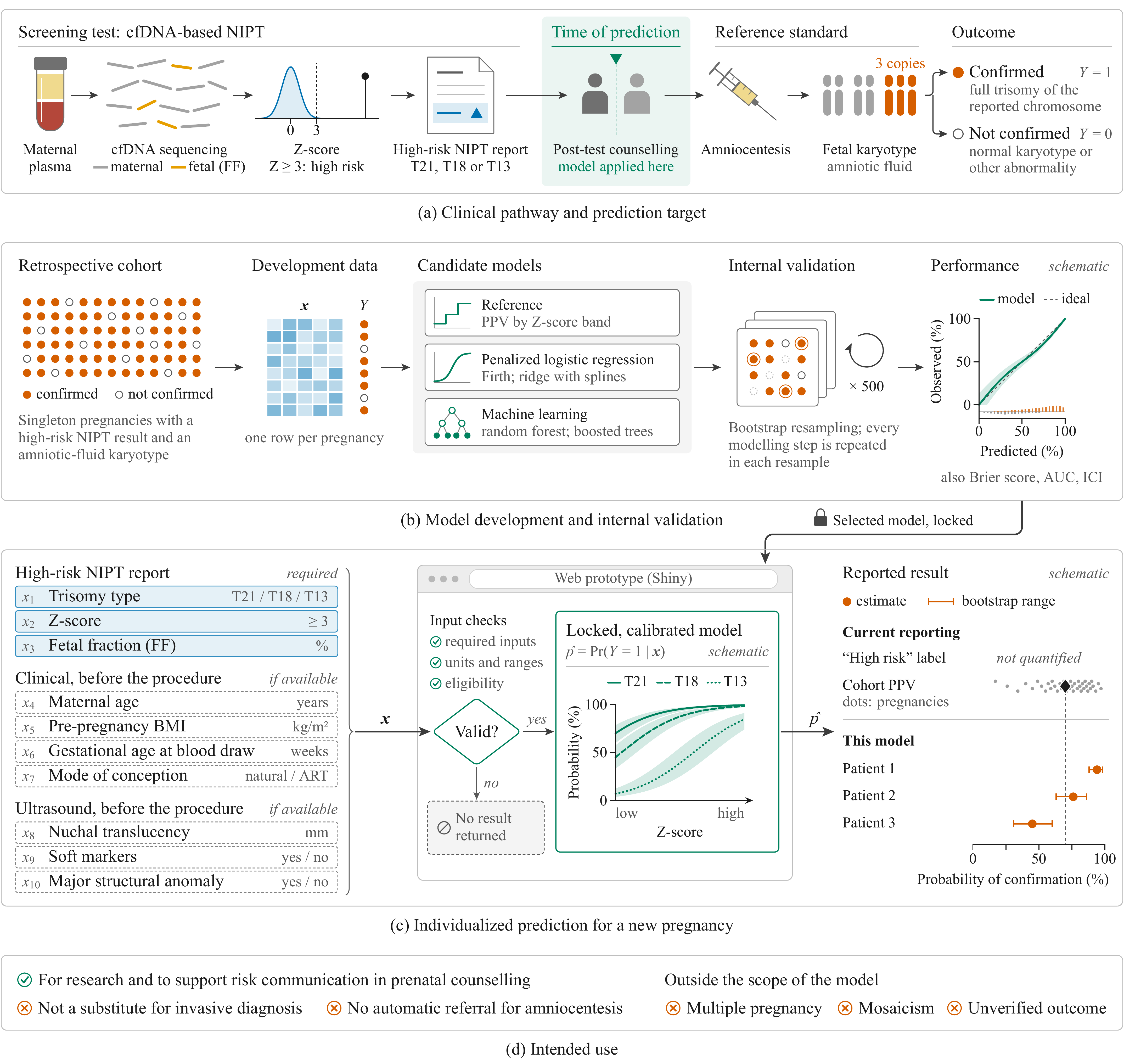
Figure 1. Study design for estimating the probability of trisomy confirmation after a high-risk NIPT result. The curves and individual pregnancy estimates are illustrative.
Research Areas: AI in Prenatal Screening · Medical Genetics · Precision Medicine
Project Overview
This project aims to develop and calibrate an artificial intelligence model for individualised probability estimation of confirmed fetal chromosomal abnormalities following high-risk non-invasive prenatal testing (NIPT), providing additional scientific evidence to inform prenatal counselling and diagnosis.
Research Background
Non-invasive prenatal testing has significantly advanced prenatal screening for fetal chromosomal abnormalities. However, a high-risk NIPT result does not constitute a definitive diagnosis.
The probability of diagnostic confirmation may vary across individual pregnancies depending on maternal characteristics, obstetric history and laboratory parameters. Integrating these sources of information through artificial intelligence and data-driven methodologies offers opportunities to improve individualised risk assessment and inform prenatal counselling.
Research Objectives
- Develop predictive models for individualised probability estimation of confirmed fetal trisomy 21, 18 and 13 following high-risk NIPT.
- Evaluate and compare machine learning approaches and statistical models.
- Calibrate and validate predictive models to improve the reliability of probability estimates.
- Develop a prototype risk assessment application for research purposes.
Methodology
The study adopts a retrospective cohort design, integrating NIPT laboratory parameters, maternal clinical characteristics and diagnostic chromosomal testing results obtained from amniotic fluid samples.
Machine learning approaches and statistical models are systematically developed, benchmarked and evaluated, with particular emphasis on discrimination, probability calibration and model robustness. The study also prioritises interpretability, transparency, reproducibility and biomedical research ethics.
Expected Outcomes
The project seeks to develop a scientifically grounded and appropriately calibrated predictive model to support individualised risk assessment in prenatal screening research.
Expected research outputs include scientific publications, predictive models and a prototype web-based research application.
Scientific and Clinical Significance
By integrating artificial intelligence, data science, medical genetics and obstetrics, this project explores how laboratory and clinical information can be leveraged to improve individualised assessment of fetal chromosomal abnormalities.
The research seeks to contribute to the advancement of precision medicine in maternal and fetal healthcare, while establishing a foundation for future research on artificial intelligence in prenatal screening and diagnosis.
The model is intended for research purposes and is not a substitute for definitive diagnostic testing or clinical judgement.