Research Areas: Artificial Intelligence in Oncology · Multimodal Deep Learning · Precision Medicine
Project Overview
This project develops a multimodal deep learning framework integrating histopathological images, gene expression profiles and clinical information to predict ER, PR and HER2 status in breast cancer, exploring the potential of artificial intelligence in tumour characterisation and precision medicine.
Research Background
Breast cancer is a highly heterogeneous malignancy characterised by diverse molecular profiles, histopathological features and clinical manifestations. Determining oestrogen receptor (ER), progesterone receptor (PR) and human epidermal growth factor receptor 2 (HER2) status plays a fundamental role in tumour characterisation and treatment selection.
Advances in artificial intelligence and biomedical data science offer opportunities to integrate complementary sources of tumour information. Rather than analysing individual data modalities independently, multimodal learning provides a computational framework for investigating complex relationships between molecular characteristics, tissue morphology and clinical features.
Research Objectives
- Develop a multimodal deep learning architecture integrating heterogeneous biomedical data.
- Jointly predict ER, PR and HER2 status in breast cancer.
- Investigate modality-specific contributions and the incremental value of multimodal learning over benchmark models.
- Evaluate model generalisability across independent patient cohorts.
Methodology
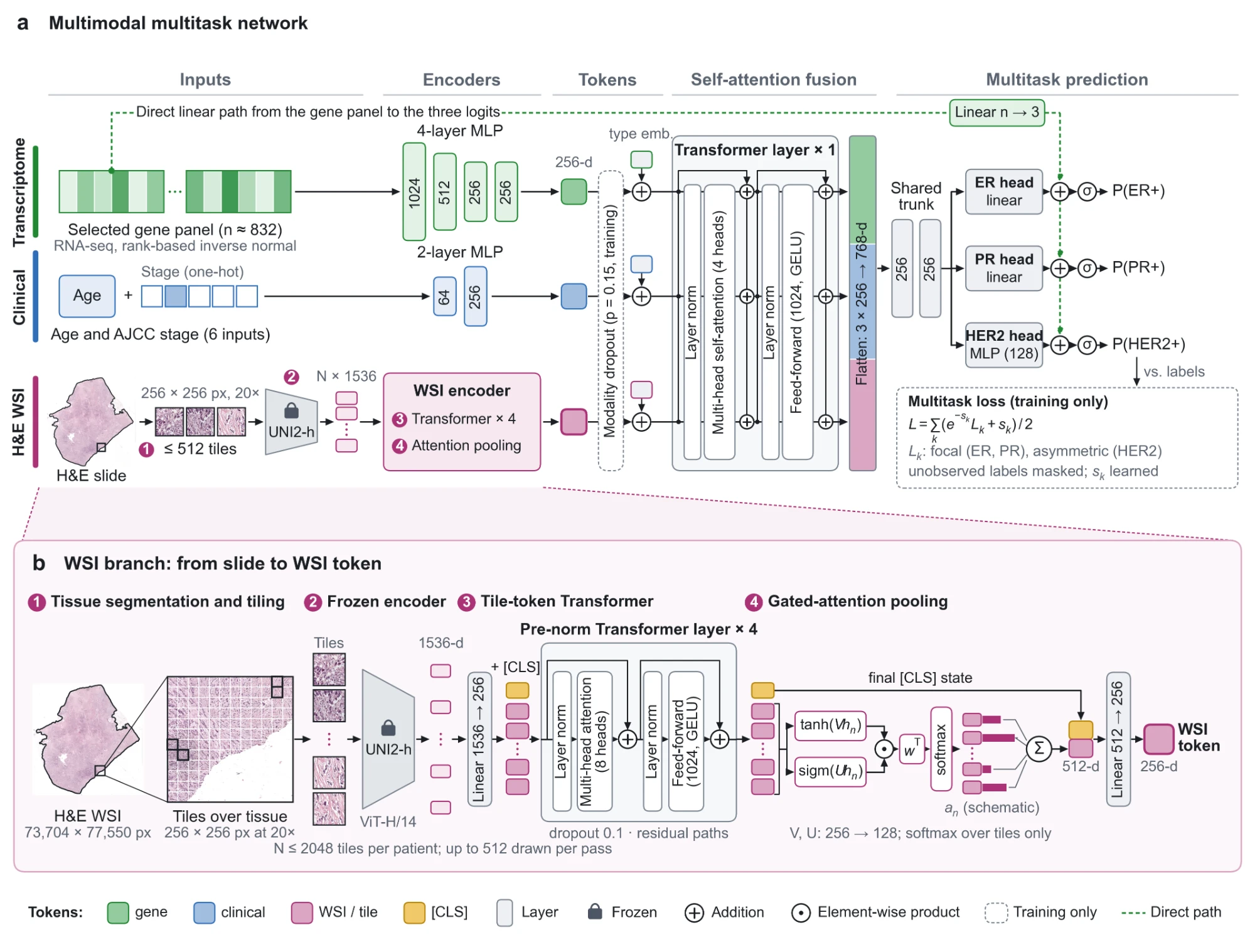
The research team develops a multimodal, multi-task deep learning framework integrating three complementary data modalities:
- Histopathological imaging: Capturing tumour morphology and tissue architecture from whole slide images (WSIs).
- Gene expression profiles: Characterising molecular features associated with breast cancer biology.
- Clinical information: Incorporating patient- and disease-specific clinical characteristics.
Modality-specific representations are learned and integrated within a unified computational architecture for ER, PR and HER2 status prediction.
The evaluation focuses on discrimination, probability calibration, cross-cohort generalisability and the incremental value of multimodal learning over benchmark approaches, with particular emphasis on transparency, reliability and reproducibility.
Research Outputs and Achievements
The initial research paper, “A Multimodal Deep Learning Framework for Breast Cancer Receptor Status Prediction”, was published in the proceedings of IUKM 2026 within Springer’s Lecture Notes in Artificial Intelligence (LNAI) series.
The research received several scientific awards in 2026:
- Third Prize at the Hanoi Medical University Young Scientists Conference.
- Second Prize at the Vietnamese Young Intellectuals Forum in Australia.
- Encouragement Award at the 23rd National Young Scientists Conference in Health Sciences.
Building upon the initial findings, the research team extended the evaluation to independent patient cohorts. The extended study has been made available as a preprint on bioRxiv and is undergoing revision following peer review at Scientific Reports, a Nature Portfolio journal.
Scientific and Clinical Significance
By bridging artificial intelligence, computational biology, pathology and oncology, this project investigates the scientific value of multimodal data integration for breast cancer characterisation.
The research contributes to the methodological foundations of computational oncology and precision medicine, providing evidence on both the potential and limitations of artificial intelligence in breast cancer research.
The developed models are intended for research purposes and have not been established as replacements for standard clinical receptor testing.